Turbine Blade Borescope Inspection: Field Guide for Aviation MRO Teams | JEET
- Share
- Issue Time
- Jun 26,2026
Summary
Practical field guide to aerospace borescope inspection — 5 hot-section zones, probe specs per zone, FAA & EASA documentation requirements, and AI-assisted defect detection status in 2026.
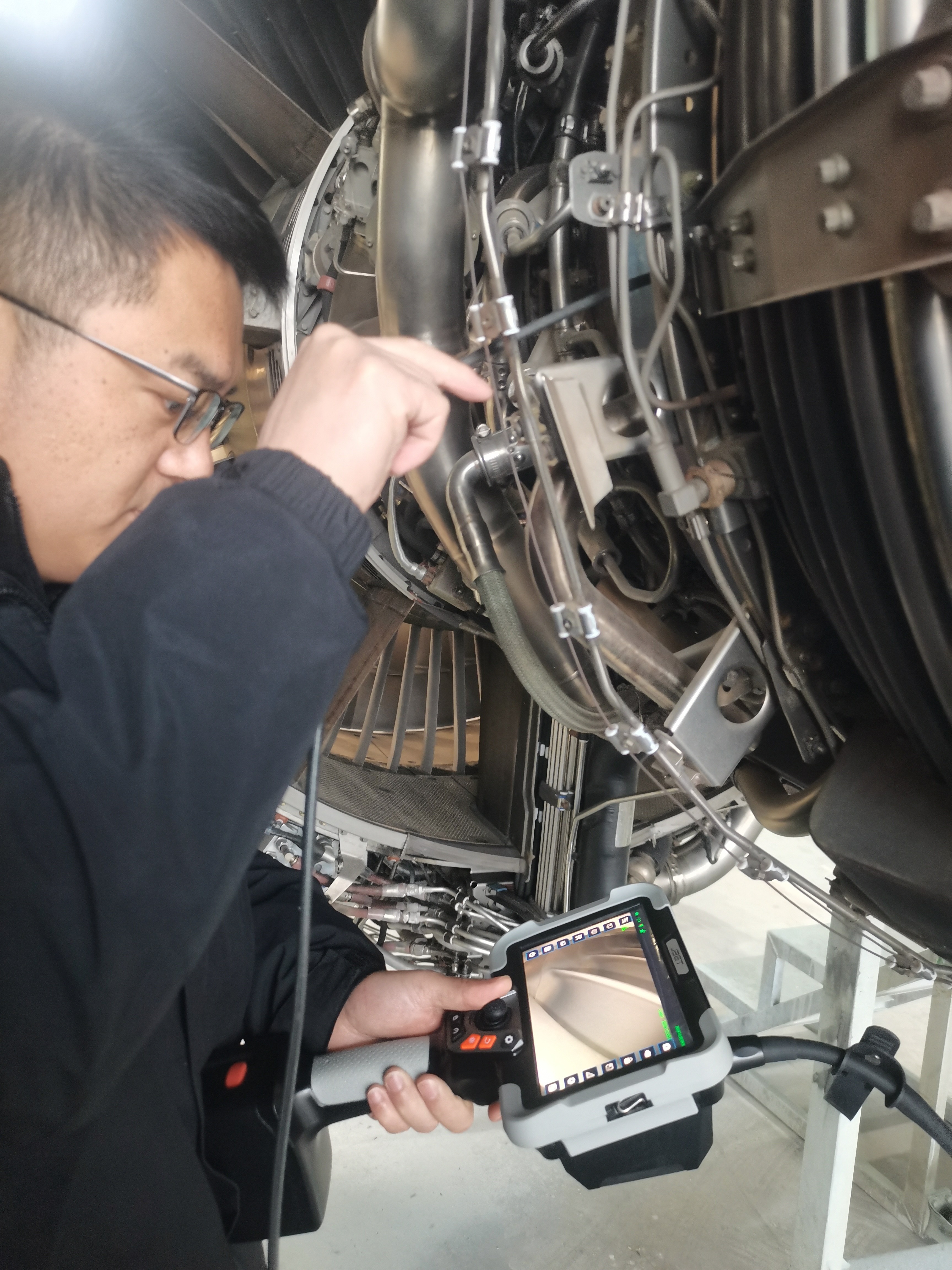
A single missed crack in a high-pressure turbine (HPT) blade can escalate from a routine borescope finding to an uncontained engine failure. For aviation MRO teams, the stakes of every inspection cycle are not measured in downtime hours but in airworthiness certificates and — ultimately — passenger safety. This field guide gives you the complete picture: which hot-section zones to cover, what probe specifications actually matter in the engine bay, how to produce inspection records that satisfy FAA AC 43.13 and EASA Part-145, and how turbine blade borescope inspection fits into a compliant, repeatable MRO workflow.
Whether you are setting up a new capability at a Part-145 repair station or upgrading aging fiberscopes to modern video borescopes, the guidance below is grounded in what actually happens inside a service facility — not the marketing brochure version.
1. Why Borescope Inspection Is Central to Engine MRO
Modern turbofan engines are designed around the assumption that internal components will be inspected at defined intervals without full disassembly. Borescope ports — precision-machined access holes built into the engine casing — exist precisely for this purpose. Skipping or shortcutting borescope inspections is not a cost-saving measure; it is a regulatory violation that can ground an aircraft and expose a repair station to enforcement action.
60–80%
of unscheduled engine removals are preceded by a borescope-detectable condition
$500K+
average cost of an unscheduled engine shop visit for a single-aisle narrowbody
<2 hrs
typical on-wing borescope inspection time for a full hot-section survey using a modern videoscope
The economics are unambiguous: a $15,000–$30,000 investment in a high-quality aerospace borescope system pays for itself on the first unscheduled removal it prevents. The inspection itself is cheap; the removal is not.
Regulatory note: FAA Advisory Circular 43.13-1B and EASA Part-145 require that borescope inspections follow the engine OEM's Engine Maintenance Manual (EMM) and that all findings — including serviceable findings — are documented in the maintenance record. "Nothing found" is a record entry, not an excuse to skip documentation.
2. The 5 Hot-Section Zones You Must Inspect
"Hot-section inspection" covers everything downstream of the combustion chamber. Each zone presents a distinct failure mode, access geometry, and acceptance criterion. Here is what every aerospace MRO borescope operator needs to know about each.
3. Probe & Camera Specifications for Aviation Environments
The engine bay is a demanding environment for any instrument. Residual heat from a recently shut-down engine, residual oil mist, and confined port geometries all constrain what a borescope system must be able to handle. The table below shows the minimum and recommended specifications for each inspection zone.
| Zone | Min Probe OD | Working Length | Min Resolution | Articulation | Measurement |
|---|---|---|---|---|---|
| HPT Blades | ≤5.5 mm | 1.0 – 1.5 m | 1080p (4K preferred) | 4-way, ≥180° | Stereo or 3D phase-shift |
| NGVs | ≤5.5 mm | 1.0 – 1.5 m | 1080p (4K preferred) | 4-way, ≥180° | Stereo (burn-through depth) |
| Combustion Liner | ≤6.0 mm | 0.8 – 1.0 m | 1080p | 4-way, ≥160° | Dimension (distortion sizing) |
| LPT Stages | ≤6.0 mm | 1.5 – 2.0 m | 1080p | 4-way, ≥160° | Tip-gap measurement |
| HPC Rear Stages | ≤4.0 mm | 1.0 m | 1080p | 4-way, ≥160° | Nick depth (shadow method) |
Tip Temperature Resistance
Even after engine shutdown, residual heat at port entry can exceed 80°C. Probe outer jackets and tip assemblies must be rated for ≥120°C continuous contact. Verify with the manufacturer — consumer-grade "inspection cameras" are not rated for these conditions.
Oil and Jet Fuel Compatibility
The insertion tube outer sheath must be rated for contact with MIL-PRF-23699 turbine oil and Jet-A fuel. Silicone sheaths are generally resistant; standard rubber sheaths may swell or degrade over time in sustained contact with these fluids.
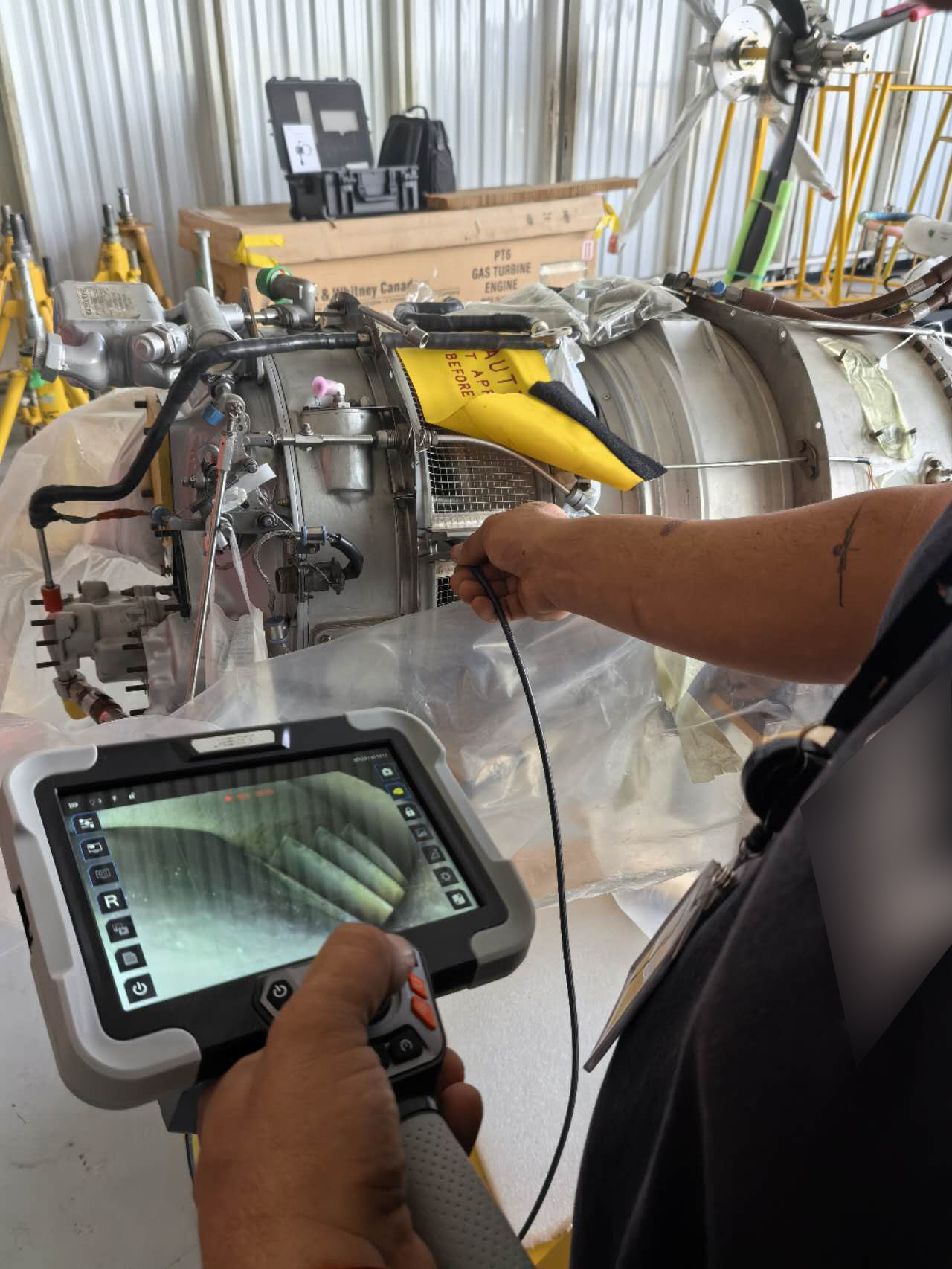
4. A Defensible 5-Step Inspection Workflow
Airworthiness regulators and airline technical operations teams do not just care whether an inspection happened — they care whether it was controlled, traceable, and repeatable. The following workflow satisfies both requirements.
Pre-inspection setup and EMM review
Pull the applicable Engine Maintenance Manual (EMM) chapter for the engine type and serial. Verify the current Airworthiness Directive (AD) list for any borescope-specific inspection requirements. Confirm the borescope system is within calibration interval and that the operator holds the appropriate authorization (Part-145 Sign-Off or equivalent).
Equipment check and probe verification
Verify probe diameter is appropriate for each port. Check articulation function and full-range tip travel. Confirm storage media (SD card / USB) is formatted and has sufficient capacity for the full inspection. Set display brightness and color balance before probe insertion — do not adjust mid-inspection, as it invalidates image comparability.
Systematic zone coverage with continuous recording
Record continuously from probe insertion to withdrawal — do not rely on still capture only. Narrate engine rotation position and zone identifier into the audio track if the system supports it. Rotate the engine in the direction specified by the EMM (fan rotation direction affects blade presentation angle at port). Cover all specified borescope positions before removing the probe from any port.
Defect characterization and measurement
When a suspected defect is identified, do not move the probe. Freeze the frame, apply measurement annotations using the on-board measurement module, and save both the measured image and the raw unprocessed still. Record: zone, engine position (clock position / blade number), finding description, measurement value, and the applicable EMM limit. Verify whether the finding is within serviceability limits before making a disposition recommendation.
Record completion and sign-off
Complete the borescope inspection report with: engine type and serial, work order number, date/time, borescope model and probe serial, operator name and authorization number, all findings (including "no defects found" for each zone), and the disposition (serviceable / repair required / requires engineering review). Attach annotated still images for each finding. File as a permanent maintenance record per applicable regulatory requirements.
Workflow tip: Create a borescope inspection task card specific to each engine type in your scope. A standardized task card ensures zone coverage is consistent across operators and shifts — critical for trend monitoring across multiple inspection events on the same engine.
5. FAA, EASA, and OEM Documentation Requirements
Documentation is not bureaucracy — it is the proof that the inspection actually happened and was conducted by a qualified person using appropriate equipment. Here is what each authority requires.
FAA (14 CFR Part 43)
- Inspector name and certificate number
- Work description and date
- Reference to applicable maintenance data (EMM section)
- Sign-off that airworthiness was determined
- Equipment used (borescope model / serial)
EASA (Part-145)
- CRS (Certificate of Release to Service) reference
- Traceability to the approved maintenance data
- Certifying staff authorization (CAME ref.)
- Photographic evidence for all findings (146.A.55)
- Disposition reference (in-limits / exceeds limits)
Engine OEM Requirements
- Use the current revision of the EMM (not expired data)
- Apply only OEM-approved acceptance limits
- Use OEM-specified measurement technique (e.g., stereo vs. shadow)
- Follow OEM disposition tree for borderline findings
- Report findings outside limits via Service Experience Reporting
⚠️ Common compliance gap: Many stations document "no defects found" without specifying which zones were inspected and from which port positions. A complete finding record must state which zones were surveyed and confirm 100% blade coverage — not just log "BSI complete."
6. AI-Assisted Defect Detection: Where It Stands in 2026
AI-assisted defect detection for aerospace borescope inspection has moved from research prototype to production-ready tool between 2024 and 2026. Several third-party platforms and at least two major borescope OEMs now offer on-device inference models for turbine blade crack and coating spallation detection.
✅ What AI Can Reliably Do Now
- Flag suspected cracks with confidence score overlay
- Detect TBC coating spallation zones (area estimation)
- Alert operator to FOD-type contact marks
- Auto-capture and label still images at flagged frames
- Generate preliminary inspection summary report
⚠️ What Still Requires Human Judgment
- Precise defect sizing against EMM limits
- Differentiating sooting from burn-through
- Disposition of borderline findings
- Sign-off and airworthiness determination
- Root cause analysis for repetitive findings
The practical value of AI in 2026 is operator augmentation, not replacement. Experienced MRO technicians who use AI-flagged inspection video as a second-pass review are detecting approximately 15–25% more sub-limit findings that would previously have been carried forward undetected — reducing the population of conditions that escalate to removals at the next inspection interval.
7. Recommended Borescope Models for Aerospace MRO
[FILL: 2–3 sentence brand introduction — e.g., "At [Brand], we design and manufacture video borescopes specifically validated for aviation MRO environments. Our products are used in certified Part-145 repair stations and MRO facilities across [regions/countries], with CE, RoHS, and [FILL: certifications] compliance."]
Inspecting a specific engine type?
Tell us your engine type, the target borescope port diameter, and your working length requirement — our applications team will confirm probe compatibility and provide a demo unit or loaner for evaluation.
Request compatibility check →8. Frequently Asked Questions
Summary
Effective turbine blade borescope inspection requires the right probe geometry for each engine port, a systematic zone coverage protocol, and documentation that satisfies both the applicable regulatory authority and the engine OEM's maintenance data. A 4K video borescope with 4-way articulation, stereo measurement capability, and on-board recording is the current baseline for Part-145 compliance in commercial aviation MRO. AI-assisted defect detection enhances detection probability but does not replace human sign-off authority.
[FILL: Brand] designs and manufactures video borescopes specifically validated for aviation MRO environments, with full technical support and direct access to application engineers who understand engine access geometry — not just camera specifications.
Request a quote or application consultation →