Automotive Borescope Guide: 4 Critical QC Inspection Zones | JEET
Automotive Borescope Guide: 4 Critical QC Inspection Zones | JEET
Share
Issue Time
Jun 18,2026
Summary
Automotive borescope inspection guide covering 4 critical engine zones: cylinder bore, oil gallery, casting porosity, and weld root. Includes production-grade camera specs, a standardized 4-step inspection workflow, and MES integration guidance for recall prevention.
TITLE TAG: Borescope Inspection in Automotive Manufacturing: Reduce Recall Risk on the Line | [FILL: Brand Name]
META DESC: Learn how video borescopes are used in automotive quality control — from cylinder bore checks to weld inspection — and how to standardize your end-of-line process.
SLUG: /blog/automotive-borescope-inspection
PRIMARY KEYWORD: automotive borescope
SECONDARY KEYWORDS: engine inspection camera, cylinder bore inspection, automotive quality control borescope, borescope for engine assembly
SCHEMA: Article, FAQPage, BreadcrumbList
A single missed casting defect in a cylinder head can trigger a recall affecting hundreds of thousands of vehicles. The financial exposure — warranty claims, regulatory fines, brand damage — can dwarf the cost of an entire production year's inspection budget. Yet many automotive plants still rely on manual visual checks or statistical sampling at end-of-line, leaving the most dangerous defect locations completely unverified.
This article explains how a properly specified automotive borescope — deployed at the right points in your assembly flow — closes that gap without slowing cycle time. We'll cover the four highest-risk inspection zones, the camera and probe specs that actually matter for production environments, and how to build a documented, repeatable process that satisfies OEM quality audits.
Modern engines are built to tighter tolerances than ever before. A cylinder bore with a surface finish outside specification by as little as 0.5 Ra µm will consume oil at an accelerated rate — the kind of defect that passes every functional test at the plant but generates thousands of customer complaints at 30,000 miles. Traditional measurement approaches — CMM, surface profilometers, gauge pins — verify geometry accurately, but they cannot see what's actually inside an assembled component.
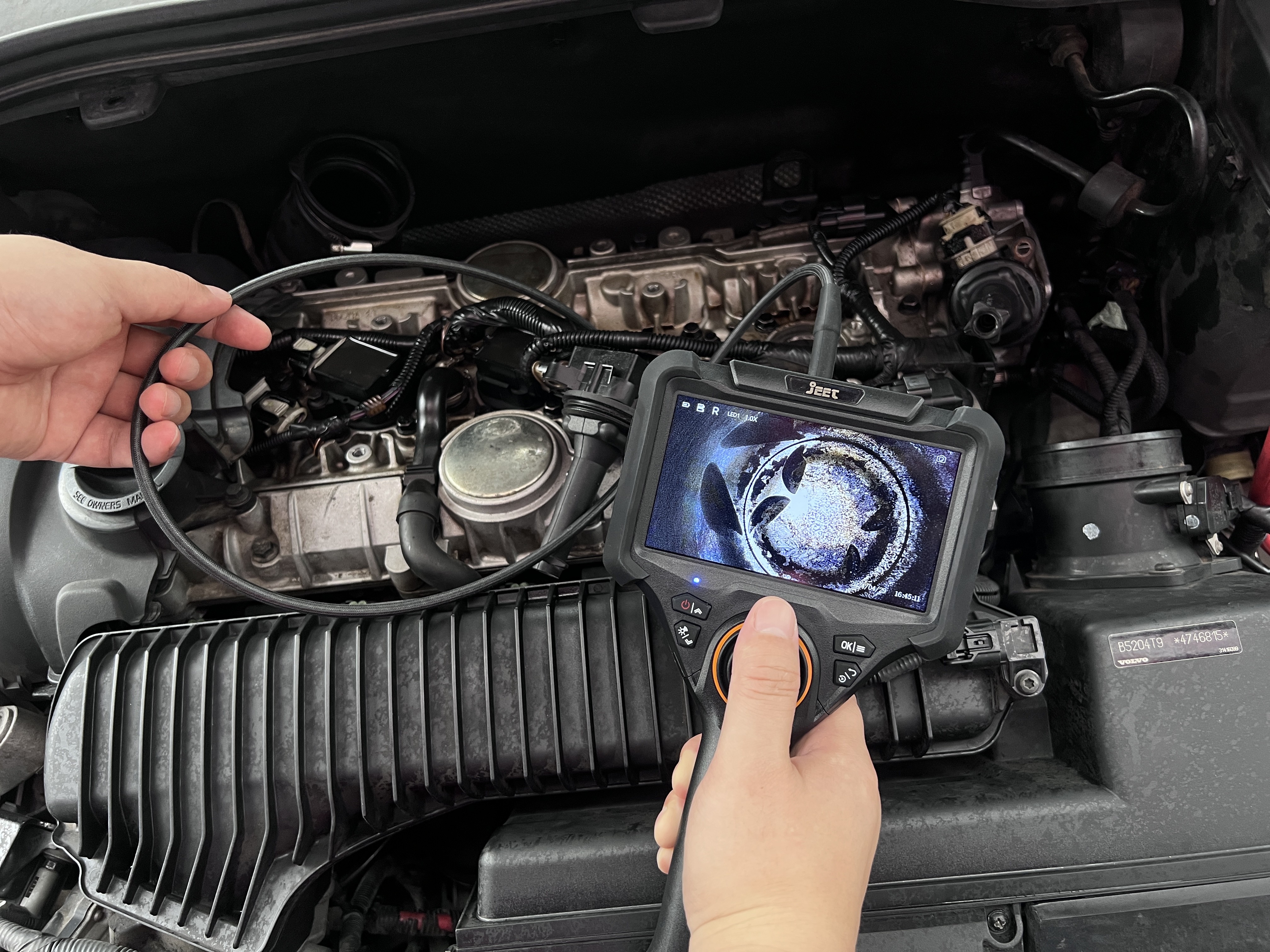
That's the gap a video engine inspection camera fills. Inserted through the spark plug port, oil fill opening, or inspection aperture, a borescope delivers live HD imagery from zones that are physically inaccessible after assembly. It's not a replacement for dimensional gauging — it's the final confirmation that nothing was missed.
$22B+
Annual automotive recall cost (NHTSA, 2024)
~30%
Of powertrain recalls traced to manufacturing defects missed at EOL
<45s
Typical cycle time for a 4-zone borescope check on a 4-cylinder engine
The economics are straightforward: at typical automotive cycle times, a full 4-zone borescope inspection adds under 45 seconds per unit. Against the cost of a single warranty claim — averaging $1,200–$4,500 depending on the repair — the inspection pays for itself after catching the first escaping defect.
2. The 4 Highest-Risk Inspection Zones
Not every cavity needs equal scrutiny. Based on failure mode data from powertrain warranty analysis, these four zones generate the highest defect escape rate and the greatest downstream repair cost.
1
Cylinder Bore Surface — Post-Honing
Honing leaves a crosshatch pattern essential for oil retention. Tool chatter, abrasive loading, or incorrect dwell time can produce smeared metal, torn hatch, or localized glazing — none of which are detectable by bore gauge.
Access point: Spark plug bore (typical ID: 14–18 mm) or direct bore opening before head assembly.
What to look for:
Smeared or folded metal over hatch valleys
Scoring marks from abrasive fragments
Glazed bands (localized burnishing)
Metallic debris or swarf remaining in bore
2
Oil Gallery Passages
Drilled oil galleries in the block and head deliver lubrication to bearings, cam journals, and the valve train. A machining burr or casting flash that breaks loose after engine start can block an oil passage entirely — causing catastrophic bearing failure within minutes of first operation.
Access point: Oil gallery plugs removed, or through feed orifices (ID as small as 4 mm).
What to look for:
Casting flash or burrs at drilled intersections
Metal chips from drilling operations
Blocked cross-drillings
Corrosion or moisture contamination in new castings
3
Casting Porosity in Cylinder Heads and Blocks
Aluminium die casting inevitably produces some subsurface porosity. Most is benign. However, porosity breaking the water jacket wall, coolant port face, or combustion chamber face creates a direct leak path — undetectable until pressure testing, and sometimes not until in-field thermal cycling opens the void further.
Subsurface voids visible as shadows in specular reflection
Casting shrinkage cracks near heavy section transitions
Misrun areas (incomplete fill) at thin walls
4
Weld Penetration in Chassis and Body Structural Assemblies
Closed-section chassis members — B-pillars, rocker panels, subframe boxes — are welded from the outside but must achieve full penetration to the inner flange to meet crash performance requirements. Once closed, the weld root is invisible without borescope access through a drain hole or pre-positioned inspection port.
Access point: Drain holes, access apertures in closed sections (typically 8–16 mm ID).
What to look for:
Cold laps or incomplete fusion at weld root
Undercut along the weld toe
Porosity or slag inclusions visible on the bead surface
Missing welds (robot skip fault)
3. Camera and Probe Specs for Production Environments
An MRO borescope designed for occasional turbine inspection is not the same tool as one that needs to survive 300 engine inspections per shift for three years on a production floor. These are the specifications that separate an industrial automotive borescope from a general-purpose instrument.
Probe Diameter: 4.0–6.0 mm for Most Powertrain Applications
Spark plug threads are typically M14×1.25 or M12×1.25, giving an entry bore of ~11–13 mm. A 4.0–5.5 mm probe fits comfortably, leaves room for tip articulation, and maintains a rigid enough shaft to push down a vertical bore without coiling. For oil gallery inspection, a 2.8–4.0 mm probe is required. Avoid probes larger than 6.0 mm unless you are inspecting through pre-designated access ports — forcing an oversized probe risks thread damage.
Articulation: 4-Way, ≥180°, with Joystick or Scroll-Wheel Control
In production environments, operators perform hundreds of repetitive inspections per shift. Thumb-joystick articulation control — rather than a manual lever — allows single-hand operation so the other hand stabilizes the engine. Articulation repeatability matters: the tip should return to center within ±2° after release, ensuring the operator can always find the home position quickly without looking at the screen.
Production floor probes encounter cutting fluid, oil mist, metal particles, and are frequently dropped or coiled under tension. A stainless steel-braided outer sheath provides crush resistance and chemical resistance far beyond plastic-jacketed probes. IP67 waterproofing on the probe allows direct wash-down cleaning between vehicles — critical in high-contamination environments.
Image Management: Direct USB/SD Export or Network Integration
Quality audit requirements increasingly mandate photographic evidence of passed inspections, not just a go/no-go stamp. A borescope with one-button still capture and automatic timestamped file naming allows operators to build a complete inspection record without additional steps. For plants running MES or ADAS quality systems, look for models with Wi-Fi export or USB-C connectivity compatible with standard industrial PC interfaces.
4. Building a Repeatable Inspection Workflow
The single biggest failure mode in automotive borescope programs is not equipment performance — it's inconsistency. Two operators using the same camera on the same engine often produce different accept/reject decisions because there's no standardized viewing sequence, no documented defect criteria, and no controlled image archive. Here's how to build a process that eliminates that variability.
1
Define the Inspection Point Map (IPM)
For each engine family, document: entry port location, probe diameter required, insertion depth at each viewing station, articulation angle, and dwell time. The IPM becomes the training document and the audit reference. New operators pass qualification only when they can execute the IPM to within ±5° articulation and ±10 mm insertion depth of the reference images.
2
Build a Visual Defect Reference Library
Collect borescope images of: a conforming bore, each defect type (smeared hatch, scoring, burr, porosity), and borderline cases. Laminate these as a physical reference card at the inspection station. Operators should match what they see on screen against the reference before pressing Accept — this alone reduces inter-operator variance by 60–80% in most implementations.
3
Standardize Image Capture and Naming
Require a minimum of 4 still images per engine (one per zone), automatically stamped with engine serial number (via barcode scan), operator ID, time, and probe position. File naming convention: [SerialNo]_[Zone]_[OperatorID]_[Timestamp].jpg. These records satisfy IATF 16949 traceability requirements and provide evidence for warranty dispute resolution.
4
Implement Monthly Gauge R&R on the Inspection System
A borescope inspection is a visual attribute gauge. AIAG MSA guidelines apply. Monthly Gauge R&R studies using a set of reference samples (confirmed good, confirmed defective, borderline) verify that your operators are agreeing with each other and with the standard. Target: <10% study variation. If you exceed this, retraining or reference library update is required before the next production shift.
5. Integration with MES and Quality Management Systems
Standalone inspection with no data connection to the plant's quality system is an island of data. The real leverage comes from connecting borescope findings to the broader MES and QMS — enabling defect trend tracking, supplier correlation, and automated build holds.
Traceability Linkage
Connect inspection images to engine serial number via barcode scan at the station. When a warranty claim arrives at the dealer, the plant quality team can pull the original borescope images for that specific engine within seconds — critical for determining whether the defect was present at build or developed in service.
Automated Build Hold
With MES integration, a borescope reject triggers an automatic build hold on that engine number — preventing it from continuing down the line to final assembly. This replaces paper-based rejection tags and eliminates the risk of a rejected unit being accidentally released through an operator error at a downstream station.
Defect Frequency Trending
Export reject counts by defect type, zone, shift, and casting batch number into your QMS SPC module. When cylinder bore scoring rejects spike after a specific honing tool change, the data connection makes that correlation visible in hours rather than weeks — before the problem reaches field vehicles.
Supplier Feedback Loop
Casting porosity defects are traceable to specific die cavity numbers. When borescope images confirm a consistent porosity pattern on engines from a specific casting batch, the images — with dimensional overlays if measurement software is used — become the evidence package for the supplier corrective action (SCAR) process.
6. Frequently Asked Questions
Can a borescope replace a bore gauge or CMM for cylinder measurement?
+
No — a standard video borescope is a qualitative visual inspection tool, not a dimensional gauge. It confirms surface condition (crosshatch quality, scoring, debris) but cannot replace a bore gauge for diameter or taper measurement. However, advanced borescopes equipped with stereo or phase-shift measurement software can perform quantitative defect sizing — measuring crack length, pit depth, or surface profile deviation to ±0.05 mm accuracy. These are complementary tools, not alternatives.
How long does a borescope probe last in a high-volume automotive production environment?
+
Probe life is highly dependent on handling and access port conditions. In controlled production environments where operators follow the IPM (no forced insertion, no contact with metal edges), a steel-braided probe should achieve 50,000–100,000 insertion cycles before tip degradation affects image quality. The most common failure modes are: LED dimming (addressable by brightness compensation), articulation cable stretch (requires recalibration), and abrasion to the outer sheath (cosmetic, not functional). Budget for probe refurbishment every 12–18 months in high-throughput applications.
What quality standards govern automotive borescope inspection?
+
There is no single standard specific to automotive borescope inspection. However, the following frameworks apply: IATF 16949 (quality management system requirements for automotive production — mandates traceability and documented inspection processes); AIAG MSA (Measurement System Analysis — applies to borescope inspection as an attribute gauge study); VDA 6.3 (process audit for automotive suppliers — visual inspection is an audited process). Specific acceptance criteria (e.g., maximum allowable porosity size, minimum crosshatch angle) are defined in the customer-specific engineering drawing and should be incorporated into your IPM.
Can AI defect detection be used for automotive borescope inspection?
+
Yes, and adoption is accelerating in high-volume powertrain plants. AI-assisted borescope systems use trained neural networks to classify surface conditions in real time — flagging anomalies for operator review rather than requiring the operator to recognize every defect class independently. Current implementations achieve >90% recall on high-contrast defects (scoring, burrs, large porosity) but remain operator-assisted for borderline and subtle surface anomalies. The primary benefit in production is speed and consistency: AI annotation means operators spend attention on reviewing flagged regions rather than scanning the entire field of view, reducing per-engine inspection time by 20–35% in validated deployments.
Is borescope inspection feasible for EV powertrains and electric motor assemblies?
+
Yes — while combustion engine bore inspection is the most established automotive application, borescopes are increasingly deployed in EV manufacturing for: stator winding inspection (verifying conductor spacing and insulation integrity through end-turn access ports), battery module inspection (checking cell-to-bus-bar weld quality through vent apertures), and gearbox planetary carrier inspection (checking cage weld and gear mesh surfaces). Probe diameters of 2.8–4.0 mm are typically required for these applications due to tighter access apertures.
Summary
Automotive borescope inspection is not a premium add-on for high-end engine programs — it's a cost-justified quality gate for any powertrain that spends time with a honing machine, a casting line, or a welding robot. The four zones covered here (cylinder bore, oil gallery, casting porosity, and structural weld root) together account for the majority of manufacturing-origin warranty claims that make it past end-of-line testing.
The implementation pathway is straightforward: select a probe sized for your smallest access port, establish an Inspection Point Map, build a defect reference library, and connect image records to your MES. Most plants that follow this process see measurable warranty reduction within two to three model years.